Showing posts with label Spain. Show all posts

Tuesday, June 20, 2006

Churros in the capital

Amor on the Paseo del Prado

The last stop on the Spanish agenda was Madrid - the capital, and almost bang smack in the centre of the country, on the plains known as the meseta. Madrid is a fairly large city, around 3.5 million or so, and originally was made the capital, as the King at the time feared the power of the church in Toledo, which was the more obvious choice for a capital.

Left: Palacio Real, Madrid. Right: Palacio Real, Aranjuez

Lavender in bloom in Aranjuez

During the time we had in Madrid, we visited the Palacio Real, an ornate Royal Palace, the Palacio Real and gardens of Aranjuez. There is a piece of music, Concierto de Aranjuez by Rodrigo which I have always enjoyed, and I was pleased that visiting the place gave me the same feeling as the music, a place of calm and retreat. We hardly saw another soul while we were there (admittedly during siesta time).

Posing with the suit of Armour at Toledo's railway station, and Puente del Alcántara

We also visited Toledo, which is known as the Imperial City. You see much of the Moorish influence in Toledo, while at the same time, a city recognisable by the Vatican as the seat of the church in Spain. The cathedral in Toledo has a great collection of artworks, particularly by El Greco as well as many other treasures. We also visited the famous El Greco work, El Entierro del Conde de Orgaz (The Burial of the Count of Orgaz) in the Iglesia de Santo Tomé and the Mezquita de Cristo de la Luz, a mosque that was later converted into a church with some nice frescos. We finished our trip to Toledo waiting in one of the most impressive railway stations I've been to (even compared to the Russian metro!!).

Interior of the railway station - tiling and stained glass windows

Back in Madrid, we visited the Monasterio de la Dezcartas, sponsored by a rich Austrian and her friends at the time of the Habsburgs in Spain where I managed to understand much of the Spanish language tour, surprisingly. I also had some time to visit the Museo del Prado, a world class museum of art (which has, as one of the highlights, Velazquez's Las Meninas. While we were in Barcelona, we got to see Picasso's work of the same name).

I think that our already late eating times got later still in Madrid... Nothing like waiting till 10 or 11pm for dinner... and on one night, we even followed with late night churros and chocolate, a Madrid must. Yum!

Late night churros and chocolate at the Chocolatería San Ginés,
and an artist replicating the works of the Museo del Prado

Sunday, June 18, 2006

Escape to the Alpujarras and Costa del Sol


Mum at the entrance to our apartment, and chimneypots of Capileira

From Granada, we hired a car (a little Opel Corsa) and hit the open road. Our destination? A couple of days relaxing in the Alpujarras, part of the Sierra Nevada range. I'd read about the Alpujarras about 2 years ago, when I read 'Driving over Lemons' by Chris Stewart. It was nice to finally see the area, after enjoying reading about it so much. I even managed to pick up an autographed copy of the book for €5.

Alpujarran views - left from our terrace, and right, the view down the valley near Orgiva
Our apartment in Bubión, the middle of three villages in the picturesque Poquiera valley, had a lovely terrace looking into the valley, and an almost constant supply of ripe (and some almost ripe) cherries. I've since found out that Rachelle and Tom stayed in the exact same apartment when they visited Bubión!We spent the time there wandering the little villages, siesta-ing (as one should definitely do when in Spain), reading and just generally relaxing. It was a great bit of time out - particularly since it was also my birthday - I've now reached the ripe old age of 25.

Whitewashed streets of Bubión
A little whitewashed church with a fabulous view of the Alpujarras
Leaving the Alpujarras, we had to drive down some crazy roads where lane markings weren't to be taken at face value, before hitting the Mediterranean coast, and driving along to Málaga. The scenery along the coast was just spectacular - the blue sea, the white towns, and the mountains in behind. After we couldn't get a booking on any trains to Madrid that day, speaking with some Renfe staff who seemed rather reluctant to help us, and finally finding bus tickets, only to find that there were no free lockers to store our luggage, I was all set out to hate Málaga. But once I actually got out and wandered around, I really liked the town.

The Alcazaba of Málaga
Finally, a free attraction - the Alcazaba, not as extensive as those in the other Andalucían cities, but a really pleasant maze to wander around, with views out over the sea, and the Costa del Sol, and a beach on the Mediterranean. We also had a great dinner by the cathedral. Patatas bravas has been one of our Spanish staples. Yum!

Playa de la Malagueta - Málaga's beach on the Costa del Sol
Málaga's gardens, and the Playa de la Malagueta


Overall, our time in Andalucía was fabulous, exceeding any expectations I may have had about what I'd find there. I can't wait to go back some time!
Boating at the port of Málaga, and a little church, San Pedro

Moorish dreaming

Moorish plasterwork and tiling in the Alhambra
View of the Alhambra from the Generalife, and the Patio de los Arrayanes, in the Nasrid Palaces

Next stop - Granada. Probably 'the' sight I wanted to see in Spain was the famous Alhambra of Granada, made up of the Alcazaba (fortress), the Generalife (the architect's garden) and the real highlight - the Nasrid Palaces. One of the design features of Islamic palaces is that the relatively simple and plain exteriors hide the elaborate decoration inside, and this is very true of the Nasrid Palaces. Once you step inside, you can walk through room after room of elaborate plaster and tilework, but it never really seems overdone at all. It was just spectacular.
Patio de la Acequia of the Generalife, and flags flying from the Alcazaba

The Alhambra is one of Spain's biggest tourist attractions, and tickets each day are limited. We had to queue in order to guarantee entry, but luckily, we got in almost straight away. Granada was the city in which we most noted the influences of nearby countries such as Morocco. We spent an afternoon in Albayzin, wandering through the market stalls, reminiscent of my time in Turkey, and stopped off in the Kasbah, for some tea and cakes.

View of Albayzin from the ornate windows of the Nasrid Palaces
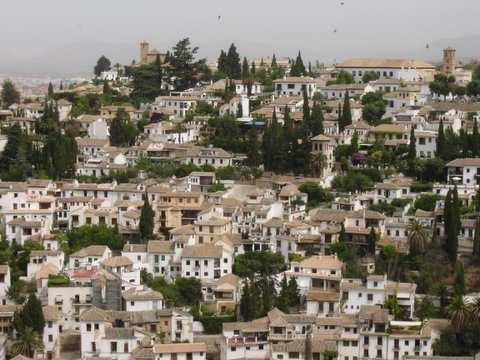
A decorated doorway of the Alhambra, and the streets of Albayzin, the Muslim Quarter of Granada

Saturday, June 17, 2006

Andalucían adventures - Valencia and Córdoba

Valencia - our stopover on the way to Andalusia. Clockwise from left: Our view over Valencia, the Lonja, a World Heritage listed monument, and one of many brides we saw in the old town of Valencia that evening.

The main reason I wanted to go to Spain was to visit the area called Andalucía, the southernmost province of Spain. Andalucía is full of spectacular architecture, which largely represents a fusion between Christian and Islamic traditions, as the area was one of the strongholds of the Islamic empire in Spain. Each of Córdoba, Sevilla and Granada served as the capital, resulting in some amazing sights in each of these cities. In addition, there is always flamenco, great food, and finally some hot summer weather!


Left: The Alcázar of Córdoba, and here I am finding solace in the Patio de los Naranjos
Ceiling decoration in the Mezquita
The Patio de los Naranjos and signature red striped arches of the Mezquita in Córdoba

Typical patio in Córdoba, and view of the Patio de los Naranjos within the Mezquita

Our Andalucian trip started in Córdoba. We took the train from Valencia, taking about six hours to travel through La Mancha (Don Quixote country) and northern Andalucía. We arrived in Córdoba around 6pm. It was a hot day, only a few degrees shy of 40, but once we'd found and settled into our hotel, we set out to see the town. Córdoba was once the capital of the Muslim Caliphate, and is the home of the fabulous Mezquita. The Mezquita was originally built as a mosque, was then extended, and then following the fall of the Islamic empire, a cathedral was plonked in the centre of it. Like many mosques, it also has a beautiful courtyard filled with orange trees (orange tree squares, or Los patios de Naranjos became quite a theme in Andalucía). The other fantastic thing about Córdoba was the old city, full of whitewashed buildings, and small winding streets, that you could just wander and lose yourself in. At this time of year, they are at their best - the front doors are opened to show the beautiful tiled courtyards, and the patios are hanging with pots of flowers. The architecture of the homes in much of Andalucía is very Islamic in origin - the homes were built around a central square, usually with a water feature, as the ambiance of running water is very important. We saw these all throughout the area. While in Córdoba, we also enjoyed a dinner of Paella and Sangría for Mum's birthday - celebrating in style!


Mum's birthday dinner in Córdoba - complete with paella and sangría

Going Gaudi in Barcelona


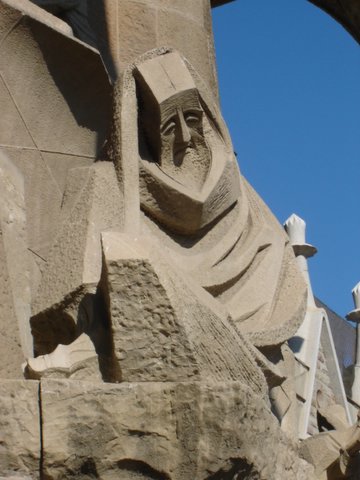
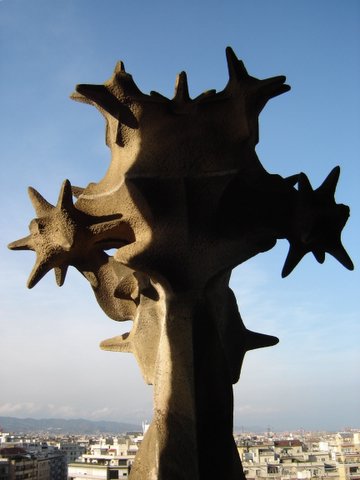
La Sagrada Familia, Gaudi's as yet unfinished cathedral masterpiece


From what everyone had told me about Barcelona, I half expected my cash, bag and camera to be ripped off me the minute I set foot in the place, but not so it seemed... I managed to complete my stay in the place with all my belongings in tact. Always a good start for a Spanish trip!

Barcelona is the capital of Catalunya, one of the more separatist oriented areas of Spain... and they don't speak Spanish, they speak Catalan. It's a fabulous city - full of unique architecture, history, and great shopping, not to mention the food!

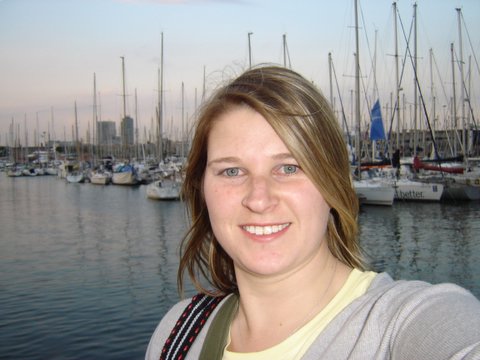
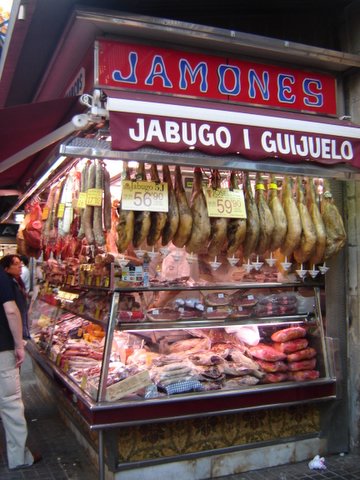
Here I am on the Barcelona waterfront, and Spanish meats for sale at the Mercado


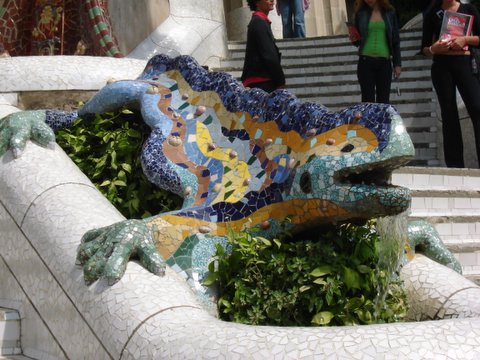
During our time in Barcelona, Mum and I checked out all the main Gaudi sights. Antoni Gaudi is a famous architecture, whose knowledge, insight and understanding of architecture resulted in buildings and structures, that are not only unique in appearance, but also aim to make the best use of light and materials. One of his main focuses was on using the lines out of nature - rarely is there a straight line in a Gaudi structure. Between La Sagrada Familia, the still unfinished, but entirely unlike anything else cathedral, La Pedrera, and Parc Guell, we were constantly inspired by what we saw.

The lizard of Parc Guell, and the terrace of La Pedrera, a Gaudi apartment building.
These are two of the many Gaudi attractions in Barcelona

We also took the furnicular up to both Montjuic - the former political prison that was spruced up for the 1992 Olympics, by creating a massive hillside of parklands, overlooking the Barcelona waterfront on the Mediterranean sea, and the hill of Tibidabo, looking over Barcelona, with a fabulous church at the top. We also ended up with an extra day in Barcelona, which saw us visit the Picasso museum, which show's the artist's development from his first works as a child in Malaga and Barcelona, on to the Blue period, the Pink period and the Cubism phases - a great insight into the development of the great Spanish artist.

And of course, no trip to Barcelona would be complete without a walk down Las Ramblas to the Waterfront, followed by some tapas and sangria. Yum!